
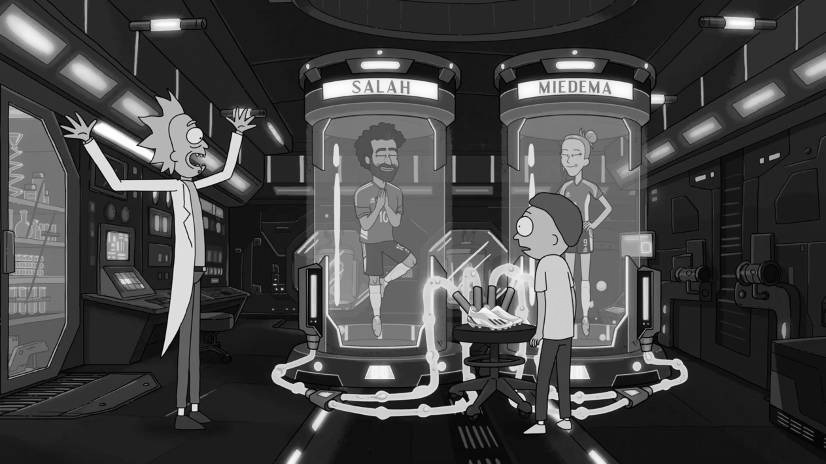
Traditional scientists have the privilege of experimenting in labs
Have you ever wondered why you feel more tired when you don’t sleep enough? Well, you have probably at some point Googled this. Without boring you too much, a quick search leads to a number of scientific sources explaining that sleep restores the body systems responsible for a rested mind, bones, and muscles. If we want to explore the link between global warming and sea levels, we can compare temperature measurements every day at consistent times against sea level measurements. To test whether a medicine works, scientists provide a treatment group with the medicine and a control group with a placebo version, and compare the results. No matter the field, we are usually able to trust findings because of credible experiments and objectively measured factors. All in all, this knowledge leads to conclusions that drastically improve our day-to-day lives!
Now, what what do scientists do in the absence when controlled experiments are impossible? And can we even trust their findings if they can’t measure things precisely? If an economist wonders whether people earning more money are happier, they will quickly find out that people in different income brackets have largely varying characteristics, ranging from psychological (grit, mentality), to health, to socioeconomic parental situations, childhoods etc. In a hypothetical world, a high-earner that is able to pay for basic healthcare necessities may report high happiness scores while someone earning less money might report high scores due to a positive family situation.
Naively, researchers can’t (or rather won’t) put two individuals in a box, give each of them a different amount of money, and ask them how happy they are. Not to mention, notions such as happiness are incredibly challenging to measure.
How do economists solve this issue?
Economists do something rather innovative. When they are unable to find perfect experiments in the world, they learn to spot them. If a government without warning decides to increase the minimum wage in one region but not its neighbor, economists can compare the two areas before and after the change. If we combine the fact that the policy change was sudden and the assumption that no inhabitants of the two regions knew of the incoming change, we have a naturally randomised experiment at hand, waiting to be analysed. Economists exploit these natural settings to mimic laboratory environments to isolate the effect of the minimum wage change on employment numbers, price levels, or self-reported worker well-being to name a few.
In other cases, economists use more elaborate statistical tools to separate cause from correlation (or coincidence). Have you ever wondered how much more money you get per year of schooling? Famous researchers have cleverly figured out that students born right after a school entry cutoff date end up with one extra year of schooling compared to those born right before the cutoff date. This strange, arbitrary, and bureaucratic rule based on birthdays, not talent or motivation, yields a perfect natural experiment to estimate what an extra year of schooling is worth in the job market. And no surprise, Angrist and Krueger (1991) from their natural experiment estimate that an extra year of schooling generally increases earnings (thankfully). When it is impossible to assign people to treatment or control groups, economists will resort to picking out natural abnormalities or shocks in rules and policies that do the randomising for us.
This is why I personally believe economics is the best science. In a fun way (my type of fun anyway), it takes the unpredictable world that we live in and turns it into experiments. Then, economists use logic and data as their instruments to figure out what improves our society. In economics, the real world is our lab with all of its natural inequality, politics, imperfect data, and complex human behaviour. With logic, theory, and smart research tricks, we’re still able to understand a lot of the mechanisms that shape our lives, our education, our happiness, and our futures.

Leave a Reply